Photographs


Every figure is a research-grade observation under CC0, CC BY or CC BY-SA, rehosted with the photographer’s name, the licence and the observation it came from. Photographs under a NonCommercial licence are excluded from this site and are never stored, which costs us a great many pictures and is not negotiable.
The specimen

- Herbarium
- The New York Botanical Garden
- Accession
- 02099980
- Filed as
- Aloe vera (L.) Burm.f.
- Det. by
- T. A. Zanoni 2014-01-01
- Collected
- B. M. Boom 2008-02-02
- Origin
- BQ
- The sheet
- View the digitised specimen (CC BY 4.0)
A real pressed plant, in a real collection, under the accession number above. Not an illustration of one. Where we hold no openly licensed sheet for a species this section is simply absent, and where a sheet never recorded who determined it, that field stays empty rather than being filled in. Roughly half of all herbarium sheets never recorded a determiner, which is ordinary.
Native range
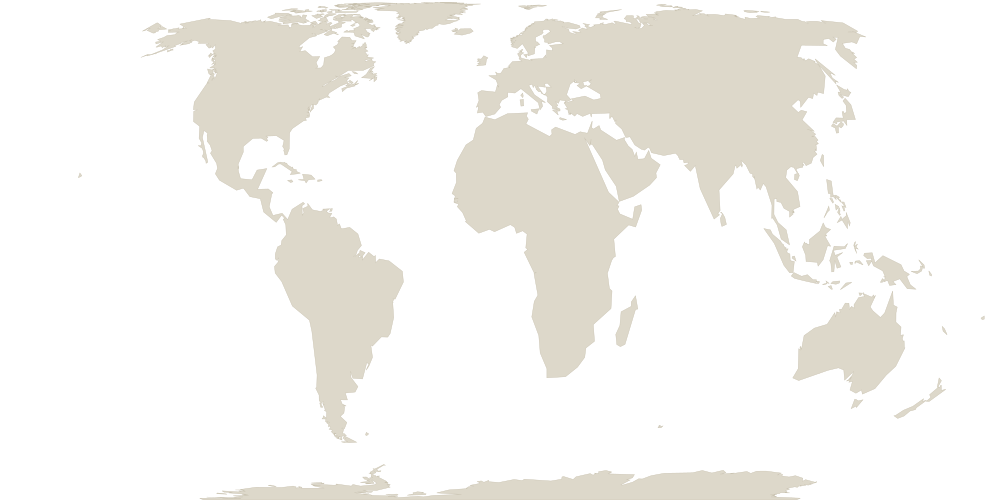
| Region | TDWG code | Continent |
|---|---|---|
| Oman | OMA | ASIA-TEMPERATE |
Region boundaries approximated from Natural Earth (public domain) and mapped to TDWG World Geographical Scheme for Recording Plant Distributions (WGSRPD) level-3 botanical countries (Brummitt 2001). Indicative, not the official WGSRPD geometry.
Flowering
| Month | In flower | Examined | Share | 95% interval |
|---|---|---|---|---|
| Jan | 9 | 12 | 75% | 47% to 91% |
| Feb | 20 | 24 | 83% | 64% to 93% |
| Mar | 17 | 19 | 89% | 69% to 97% |
| Apr | 12 | 16 | 75% | 51% to 90% |
| May | 6 | 9 | 67% | 35% to 88% |
| Jun | 1 | 2 | too few examined | |
| Jul | 2 | 5 | 40% | 12% to 77% |
| Aug | 1 | 2 | too few examined | |
| Sep | 5 | 9 | 56% | 27% to 81% |
| Oct | 2 | 5 | 40% | 12% to 77% |
| Nov | 3 | 7 | 43% | 16% to 75% |
| Dec | 8 | 11 | 73% | 43% to 90% |
Peak flowering in Mar. Each bar is the share of Aloe vera observations in which someone actually recorded the reproductive state and found the plant in flower, not the raw number of flowering records. That distinction matters: people observe plants far more in spring than in winter, so a bare count of flowering records partly measures when people go outside. Dividing by the number examined removes that. 86 of 121 examined observations were in flower, every one of them research grade. The whisker on each bar is a 95% Wilson interval. 2 months have fewer than 5 examined observations, so no proportion is drawn for them. This is still a global aggregate and not a forecast for your garden: the same species flowers on different dates in different hemispheres. Where a species has fewer than 30 flowering records we do not draw this chart at all. Computed from 10.15468/dl.cgje2x.
Where it actually grows
| Condition | 5th percentile | Median | 95th percentile |
|---|---|---|---|
| Coldest month, mean daily low | 5.9 °C | 16.8 °C | 25.0 °C |
| Warmest month, mean daily high | 23.0 °C | 28.2 °C | 36.3 °C |
| Annual rainfall | 197 mm | 686 mm | 2,247 mm |
| Rainfall in the driest quarter | 2 mm | 51 mm | 245 mm |
It is barely found anywhere that freezes. This is not care advice and it is not a forecast. It is a measurement: we sampled the climate at every one of the 2,004 research-grade observations of Aloe vera that carry a coordinate, and this is the range those places actually span. The 5th and 95th percentiles are used rather than the minimum and maximum, because a single cultivated specimen in a heated conservatory should not widen a tropical plant's range to the Arctic.
This is not a hardiness zone. A USDA zone is the average annual extreme minimum temperature. The figure above is the mean daily minimum of the coldest month, which is a different quantity and is typically far warmer. Reading one as the other would place a plant several zones too warm, so we do not publish a hardiness zone, because we do not have one. Climate from CHELSA V2.1 (Karger et al. 2017); occurrences from 10.15468/dl.cgje2x.
Traits
How Aloe vera grows, merged from four structured plant databases and a set of traits read from public-domain field guides. This is a record of documented characteristics, not care advice; each value keeps the source that reported it, and a value read from prose is tagged extracted so it is never mistaken for a measured fact.
Form and habit
- Growth habit
-
- herb USDA PLANTS / GIFT / EOL TraitBank
- Woodiness
-
- non-woody GIFT
- Succulence
-
- succulent GIFT
- Life form
-
- hemicryptophyte GIFT
- Growth form
-
- Single Stem EOL TraitBank
Size
- Height
-
- 1 m GIFT
Foliage
- Leaf retention
-
- evergreen GIFT / EOL TraitBank
Life cycle
- Life cycle
-
- perennial USDA PLANTS / GIFT / EOL TraitBank
Flowers and fruit
- Flower colour
-
- yellow GIFT
- Flowering months
-
- Jan-Dec GIFT
Physiology
- Photosynthetic pathway
-
- CAM GIFT
USDA PLANTS, GIFT, Wikidata, EOL TraitBank (via Zenodo) and traits mined from USDA NRCS plant guides. per source (public domain, CC BY 4.0, CC0). Synced 2026-07-19. Merged per species: USDA PLANTS (public domain) and GIFT (CC BY 4.0) for structured growth traits, Wikidata (CC0) for fruit type and height, and EOL TraitBank via Zenodo (per record CC0 or CC BY). A fifth set is mined from public-domain USDA NRCS plant guides, each value carrying its verbatim quote. Values tagged extracted were read from prose, never a structured record; where sources disagree, every value is kept with its own source.
Uses
Kew records Aloe vera as a useful plant in these 7 categories. This is a record that the species is used, drawn from a checklist of economically useful plants. It is not a recommendation, a dose, or a safety claim, and where a category reads Medicines or Poisons that is a use somebody documented, not advice from us.
- Human Food
- Materials
- Medicines
- Poisons
- Social Uses
- Environmental Uses
- Gene Sources
Kew World Checklist of Useful Plant Species. CC-BY 4.0. Synced 2026-07-18.
Phytochemistry
Compounds reported in Aloe vera, ranked by notability. Each activity below is one attributed to that compound in the literature, not a claim about the plant or a reason to consume it. This is a snapshot of published reports from 1992-2016, not a fresh assay, so absence here means "not in this dataset", not "not present".
- Barbaloin Antibacterial, Antihistaminic, Antitubercular, Laxative, Pesticide, Purgative
- Aloins no activities recorded in this dataset
- Anthraquinones Antilithic, Bird Repellent, Carcinogenic, Laxative, Litholytic, Toxic
- 10 Hydroxyaloin a no activities recorded in this dataset
- 7 Hydroxy 8 o methyl aloin a no activities recorded in this dataset
- Ascorbic acid Acidulant, Aldose Reductase Inhibitor, Analgesic, Angiotensin Receptor Blocker, AntiAGE, AntiCFS, AntiCTS, AntiCrohn's
- 7 Hydroxy 8 o methyl aloin b no activities recorded in this dataset
- Isorabaichromone no activities recorded in this dataset
- 10 Hydroxyaloin b no activities recorded in this dataset
- Folic acid AntiSpina Bifida, Antianemic, Anticervicaldysplasic, Anticheilitic, Anticoronary, Antidementia, Antidepressant, Antigingivitic
- Aloe emodin Antibacterial, Antiherpetic, Antileukemic, Antisalmonella, Antiseptic, Antistaphylococcic, Antitumor, Antiviral
- Folacin AntiSpina Bifida, Antianemic, Anticervicaldysplasic, Anticheilitic, Antidepressant, Antigingivitic, Antiglossitic, Antimyelotoxic
Dr. Duke's Phytochemical & Ethnobotanical Database. CC0. Synced 2026-07-18. Compiled 1992-2016 and not since updated; a record of what was reported, not a current analysis.
Interactions
Species recorded interacting with Aloe vera in the wild, grouped by the kind of interaction. These are observations aggregated from many studies; the partners shown are the most frequently recorded for each type, and this is a record of what was observed, not a complete list.
- Apis cerana
- Apis mellifera
- Bombus sonorus
- Chlorostilbon lucidus
- Coereba flaveola
- Frieseomelitta nigra
- Hoplitis biscutellae
- Icterus cayanensis pyrrhopterus
- Junonia lemonias
- Polistes myersi curassavicus
- Acanthorhynchus tenuirostris
- Anthracothorax dominicus
- Apis mellifera
- Calypte anna
- Euroxenus vayssieresi
- Felidae
- Frieseomelitta nigra
- Ibidoecus longiclypeatus
- Aloephagus myersi
- Bacillus cereus
- Pseudomonas aeruginosa
Global Biotic Interactions (GloBI). CC-BY 4.0 (aggregate) / per-source. Synced 2026-07-18. Aggregated across many source datasets by GloBI; at this aggregation level provenance is asserted for GloBI as a whole, not per partner. Joined on the accepted binomial and capped at the eight most frequently recorded partners per interaction type.
Names in other languages
What Aloe vera is called elsewhere, grouped by language. Recorded verbatim from open sources; where a language has more than one common name, both are shown.
- English
- Barbados aloe, Aloe
- Spanish
- acibar, acíbar
- Chinese
- 库拉索芦荟, 吉拉索蘆薈
- Portuguese
- aloé, aloé-dos-barbados
- German
- echte Aloe
- French
- Aloès vrai, Aloès amer, Mazambron, Aloès curaçao, Aloès des Barbades, Aloès vulgaire, Aloès vrai, Aloès curaçao, Aloès des Barbades, Aloès vulgaire
- Swedish
- äkta aloe
- Greek
- allas, aloi
- Slovenian
- prava aloja
- Maltese
- żabbara
Wikidata (P1843, CC0) + GBIF vernacular names. CC0 / per-source. Synced 2026-07-18. Wikidata is preferred where both sources give a name; GBIF supplements it. Joined on the World Flora Online identifier (Wikidata) or an exact GBIF species match.
Nomenclature
Aloe vera was named by (L.) Burm.f., first published in Fl. Indica 83 (1768). This is the nomenclatural record, who published the name and where, not a description of the plant.
- Author
- (L.) Burm.f.
- Published in
- Fl. Indica 83, 1768
- IPNI
- 530017-1
IPNI (International Plant Names Index). CC-BY 4.0. Synced 2026-07-18. The protologue citation and IPNI record, joined to this species on its World Flora Online identifier where IPNI carries one, else on the exact binomial with authorship.
Also published as
A synonym is not an error. It is a record of botanists disagreeing, in print, about where this plant belongs. Each of these was somebody’s considered answer.
- Aloe barbadensis Mill.
- Aloe barbadensis var. chinensis Haw.
- Aloe chinensis Steud.
- Aloe elongata Murray
- Aloe flava Pers.
- Aloe indica Royle
- Aloe lanzae Tod.
- Aloe maculata Forssk.
- Aloe perfoliata var. barbadensis (Mill.) Aiton
- Aloe perfoliata var. vera L.
- Aloe rubescens DC.
- Aloe variegata Forssk.
- Aloe vera var. chinensis (Steud. ex Baker) Baker
- Aloe vera var. lanzae Baker
- Aloe vera var. littoralis J.Koenig ex Baker
- Aloe vulgaris Lam.
Sources
- 01 World Flora Online Plant List. accepted name, authority, classification. CC0. Retrieved 2026-07-12.
- 02 iNaturalist. photographs, flowering annotations and the common name, CC0 / CC BY / CC BY-SA only. per photograph. Retrieved 2026-06-27.
- 03 Kew, World Checklist of Vascular Plants (WCVP v16). native distribution by TDWG level-3 botanical country, and life form. CC BY 3.0. Retrieved 2026-06-04.
We publish what we can source and we say so when we cannot. This page has no care advice and no toxicity claim, because we do not yet have those from a source we can cite.