Persicaria glabra(Willd.) M.Gómez

denseflower knotweed

WFO wfo-0000488415 Accepted WFO 2026-06 8 photographs CC0 / CC BY

Plate 1 figs. a–h · 8 separate observations

Persicaria glabra, photographed by 葉子
fig. a 葉子, CC0 1.0 / 2022-01-06 / obs. 178177807

Every figure is a research-grade observation under CC0, CC BY or CC BY-SA, rehosted with the photographer’s name, the licence and the observation it came from. Photographs under a NonCommercial licence are excluded from this site and are never stored, which costs us a great many pictures and is not negotiable.

Native range 67 botanical countries
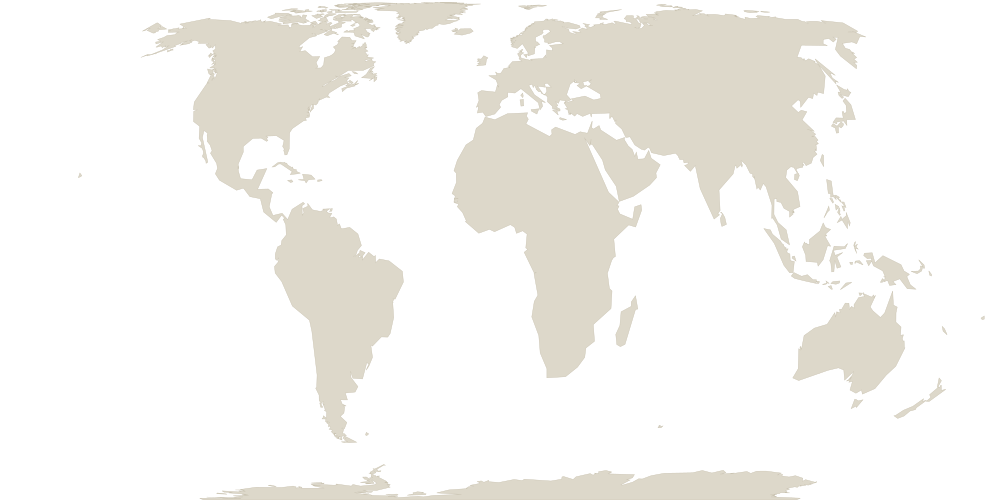
Regions where Persicaria glabra is native: Central African Republic, Ethiopia, Socotra, Sudan-South Sudan, China South-Central, China Southeast, Hainan, Oman, Saudi Arabia, Taiwan, Yemen, Assam, Bangladesh, East Himalaya, India, Jawa, Myanmar, Nepal, Pakistan, Philippines, Sri Lanka, Thailand, Vietnam, West Himalaya, Alabama, Arkansas, Delaware, Florida, Georgia, Illinois, Kentucky, Louisiana, Maryland, Mexico Central, Mexico Gulf, Mexico Northeast, Mexico Northwest, Mexico Southeast, Mexico Southwest, Mississippi, Missouri, New Jersey, North Carolina, South Carolina, Tennessee, Texas, Virginia, Argentina Northeast, Argentina Northwest, Bolivia, Brazil South, Brazil Southeast, Brazil West-Central, Cayman Is., Colombia, Cuba, Dominican Republic, Guatemala, Haiti, Honduras, Jamaica, Nicaragua, Paraguay, Peru, Puerto Rico, Uruguay, Venezuela Central African RepublicEthiopiaSudan-South SudanChina South-CentralChina SoutheastHainanOmanSaudi ArabiaTaiwanYemenAssamBangladeshEast HimalayaIndiaJawaMyanmarNepalPakistanPhilippinesSri LankaThailandVietnamWest HimalayaAlabamaArkansasFloridaGeorgiaIllinoisKentuckyLouisianaMarylandMexico CentralMexico GulfMexico NortheastMexico NorthwestMexico SoutheastMexico SouthwestMississippiMissouriNew JerseyNorth CarolinaSouth CarolinaTennesseeTexasVirginiaArgentina NortheastArgentina NorthwestBoliviaBrazil SouthBrazil SoutheastBrazil West-CentralColombiaCubaDominican RepublicGuatemalaHaitiHondurasJamaicaNicaraguaParaguayPeruPuerto RicoUruguayVenezuela DelawareCayman Is.
Native distribution of Persicaria glabra, after Kew’s World Checklist of Vascular Plants. Introduced, extinct and doubtful records are excluded, so this is where the plant is from, not everywhere it now grows. Regions too small to draw at this scale are marked with a dot.
RegionTDWG codeContinent
Alabama ALA NORTHERN AMERICA
Arkansas ARK
Delaware DEL
Florida FLA
Georgia GEO
Illinois ILL
Kentucky KTY
Louisiana LOU
Maryland MRY
Mexico Central MXC
Mexico Gulf MXG
Mexico Northeast MXE
Mexico Northwest MXN
Mexico Southeast MXT
Mexico Southwest MXS
Mississippi MSI
Missouri MSO
New Jersey NWJ
North Carolina NCA
South Carolina SCA
Tennessee TEN
Texas TEX
Virginia VRG
Argentina Northeast AGE SOUTHERN AMERICA
Argentina Northwest AGW
Bolivia BOL
Brazil South BZS
Brazil Southeast BZL
Brazil West-Central BZC
Cayman Is. CAY
Colombia CLM
Cuba CUB
Dominican Republic DOM
Guatemala GUA
Haiti HAI
Honduras HON
Jamaica JAM
Nicaragua NIC
Paraguay PAR
Peru PER
Puerto Rico PUE
Uruguay URU
Venezuela VEN
Assam ASS ASIA-TROPICAL
Bangladesh BAN
East Himalaya EHM
India IND
Jawa JAW
Myanmar MYA
Nepal NEP
Pakistan PAK
Philippines PHI
Sri Lanka SRL
Thailand THA
Vietnam VIE
West Himalaya WHM
China South-Central CHC ASIA-TEMPERATE
China Southeast CHS
Hainan CHH
Oman OMA
Saudi Arabia SAU
Taiwan TAI
Yemen YEM
Central African Republic CAF AFRICA
Ethiopia ETH
Socotra SOC
Sudan-South Sudan SUD

Not drawn on the map: Socotra. We hold no public-domain boundary for this region, so it is listed rather than guessed at.

Region boundaries approximated from Natural Earth (public domain) and mapped to TDWG World Geographical Scheme for Recording Plant Distributions (WGSRPD) level-3 botanical countries (Brummitt 2001). Indicative, not the official WGSRPD geometry.

Flowering 64 in flower of 76 examined

Proportion of examined Persicaria glabra in flower, by month
Month In flower Examined Share 95% interval
Jan 3 3 too few examined
Feb 2 3 too few examined
Mar 3 4 too few examined
Apr 7 8 88% 53% to 98%
May 1 1 too few examined
Jun 3 6 50% 19% to 81%
Jul 2 2 too few examined
Aug 6 7 86% 49% to 97%
Sep 8 9 89% 56% to 98%
Oct 14 16 88% 64% to 97%
Nov 10 11 91% 62% to 98%
Dec 5 6 83% 44% to 97%

Peak flowering in Nov. Each bar is the share of Persicaria glabra observations in which someone actually recorded the reproductive state and found the plant in flower, not the raw number of flowering records. That distinction matters: people observe plants far more in spring than in winter, so a bare count of flowering records partly measures when people go outside. Dividing by the number examined removes that. 64 of 76 examined observations were in flower, every one of them research grade. The whisker on each bar is a 95% Wilson interval. 5 months have fewer than 5 examined observations, so no proportion is drawn for them. This is still a global aggregate and not a forecast for your garden: the same species flowers on different dates in different hemispheres. Where a species has fewer than 30 flowering records we do not draw this chart at all. Computed from 10.15468/dl.cgje2x.

Also published as 5 synonyms

A synonym is not an error. It is a record of botanists disagreeing, in print, about where this plant belongs. Each of these was somebody’s considered answer.

  • Persicaria densiflora Moldenke
  • Persicaria portoricensis Small
  • Polygonum densiflorum Meisn.
  • Polygonum glabrum Willd.
  • Polygonum portoricense Bert. ex Endl.

Sourcesevery claim on this page

  1. World Flora Online Plant List. accepted name, authority, classification. CC0. Retrieved 2026-07-12.
  2. iNaturalist. photographs and flowering annotations, CC0 / CC BY / CC BY-SA only. per photograph. Retrieved 2026-06-27.
  3. USDA PLANTS Database. common name, checklist symbol POGL10. public domain. Retrieved 2026-07-13.
  4. Kew, World Checklist of Vascular Plants (WCVP v16). native distribution by TDWG level-3 botanical country, and life form. CC BY 3.0. Retrieved 2026-06-04.

We publish what we can source and we say so when we cannot. This page has no care advice and no toxicity claim, because we do not yet have those from a source we can cite.