Plate 1 figs. a–h · 8 separate observations


Every figure is a research-grade observation under CC0, CC BY or CC BY-SA, rehosted with the photographer’s name, the licence and the observation it came from. Photographs under a NonCommercial licence are excluded from this site and are never stored, which costs us a great many pictures and is not negotiable.
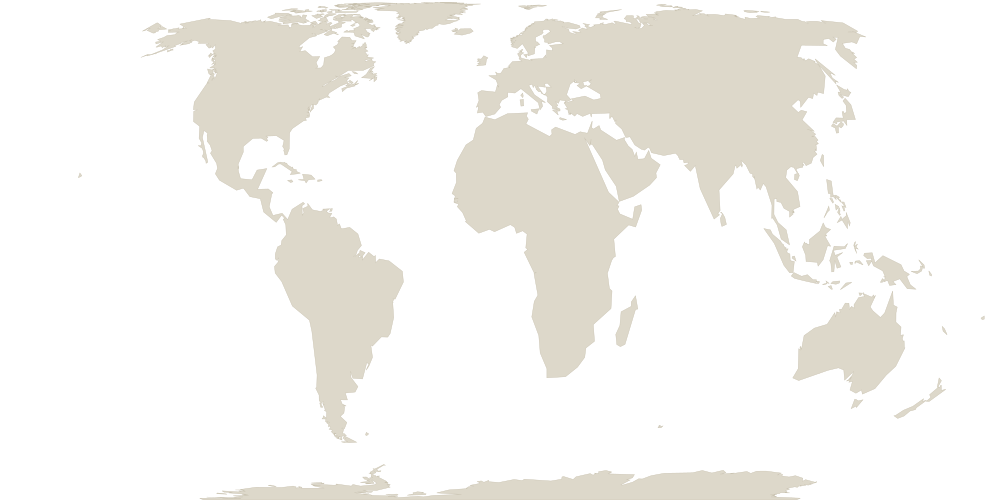
Native range 12 botanical countries
| Region | TDWG code | Continent |
|---|---|---|
| Alabama | ALA | NORTHERN AMERICA |
| Delaware | DEL | |
| District of Columbia | WDC | |
| Georgia | GEO | |
| Kentucky | KTY | |
| Louisiana | LOU | |
| Maryland | MRY | |
| Mississippi | MSI | |
| North Carolina | NCA | |
| South Carolina | SCA | |
| Tennessee | TEN | |
| Virginia | VRG |
Region boundaries approximated from Natural Earth (public domain) and mapped to TDWG World Geographical Scheme for Recording Plant Distributions (WGSRPD) level-3 botanical countries (Brummitt 2001). Indicative, not the official WGSRPD geometry.
Flowering 129 in flower of 143 examined
Peak flowering in May. Each bar is the share of Odontostephana carolinensis observations in which someone actually recorded the reproductive state and found the plant in flower, not the raw number of flowering records. That distinction matters: people observe plants far more in spring than in winter, so a bare count of flowering records partly measures when people go outside. Dividing by the number examined removes that. 129 of 143 examined observations were in flower, every one of them research grade. The whisker on each bar is a 95% Wilson interval. 8 months have fewer than 5 examined observations, so no proportion is drawn for them. This is still a global aggregate and not a forecast for your garden: the same species flowers on different dates in different hemispheres. Where a species has fewer than 30 flowering records we do not draw this chart at all. Computed from 10.15468/dl.cgje2x.
Also published as 13 synonyms
A synonym is not an error. It is a record of botanists disagreeing, in print, about where this plant belongs. Each of these was somebody’s considered answer.
- Asclepias acanthocarpus J.F.Gmel. ex Decne.
- Cynanchum carolinense Jacq.
- Cynanchum hirsutum (Michx.) Pers.
- Cynanchum hirtum L.
- Cynanchum macrophyllum Pers.
- Echites truncatus (Jacq.) Lam.
- Gonolobus carolinensis (Jacq.) Schult.
- Gonolobus hirsutus Michx.
- Gonolobus hirtus (L.) Schult.
- Matelea carolinensis (Jacq.) Woodson
- Vincetoxicum acanthocarpos Walter
- Vincetoxicum carolinense (Jacq.) Britton
- Vincetoxicum hirsutum (Michx.) Britton
Sourcesevery claim on this page
- World Flora Online Plant List. accepted name, authority, classification. CC0. Retrieved 2026-07-12.
- iNaturalist. photographs and flowering annotations, CC0 / CC BY / CC BY-SA only. per photograph. Retrieved 2026-06-27.
- USDA PLANTS Database. common name, checklist symbol MACA9. public domain. Retrieved 2026-07-13.
- Kew, World Checklist of Vascular Plants (WCVP v16). native distribution by TDWG level-3 botanical country, and life form. CC BY 3.0. Retrieved 2026-06-04.
We publish what we can source and we say so when we cannot. This page has no care advice and no toxicity claim, because we do not yet have those from a source we can cite.