Cyperus sesquiflorus(Torr.) Mattf. & Kük.

fragrant spikesedge

WFO wfo-0000382526 Accepted WFO 2026-06 8 photographs CC0 / CC BY

Plate 1 figs. a–h · 8 separate observations

Cyperus sesquiflorus, photographed by Thomas Mesaglio
fig. a Thomas Mesaglio, CC BY 4.0 / 2022-04-30 / obs. 192137147

Every figure is a research-grade observation under CC0, CC BY or CC BY-SA, rehosted with the photographer’s name, the licence and the observation it came from. Photographs under a NonCommercial licence are excluded from this site and are never stored, which costs us a great many pictures and is not negotiable.

Native range 111 botanical countries
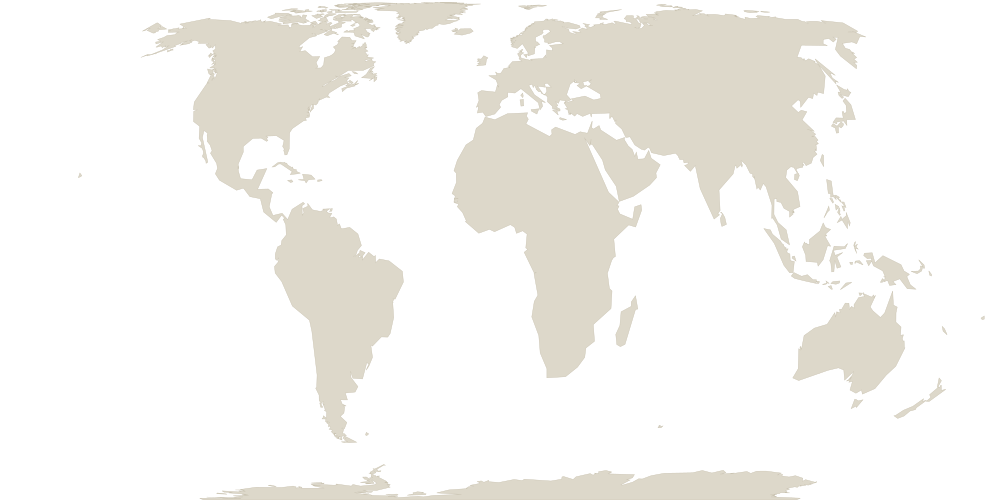
Regions where Cyperus sesquiflorus is native: Angola, Benin, Botswana, Burkina, Cameroon, Cape Provinces, Central African Republic, Chad, Congo, DR Congo, Equatorial Guinea, Eswatini, Ethiopia, Gabon, Ghana, Guinea, Guinea-Bissau, Gulf of Guinea Is., Ivory Coast, Kenya, KwaZulu-Natal, Liberia, Madagascar, Malawi, Mali, Mauritius, Mozambique, Nigeria, Northern Provinces, Réunion, Rodrigues, Rwanda, Senegal, Sierra Leone, Somalia, Sudan-South Sudan, Tanzania, Togo, Uganda, Zambia, Zimbabwe, China South-Central, China Southeast, Nansei-shoto, Taiwan, Yemen, Andaman Is., Assam, Bangladesh, Borneo, East Himalaya, India, Jawa, Lesser Sunda Is., Maluku, Nepal, New Guinea, Philippines, Sri Lanka, Sumatera, Thailand, Vietnam, New South Wales, Northern Territory, Queensland, Alabama, Arkansas, Florida, Georgia, Louisiana, Mexico Central, Mexico Gulf, Mexico Northeast, Mexico Northwest, Mexico Southeast, Mexico Southwest, Mississippi, New Mexico, North Carolina, Oklahoma, South Carolina, Texas, Argentina Northeast, Argentina Northwest, Belize, Bolivia, Brazil North, Brazil Northeast, Brazil West-Central, Colombia, Costa Rica, Cuba, Dominican Republic, Ecuador, El Salvador, French Guiana, Guatemala, Guyana, Honduras, Jamaica, Leeward Is., Nicaragua, Panamá, Paraguay, Peru, Puerto Rico, Suriname, Trinidad-Tobago, Uruguay, Venezuela, Windward Is. AngolaBeninBotswanaBurkinaCameroonCape ProvincesCentral African RepublicChadCongoDR CongoEquatorial GuineaEswatiniEthiopiaGabonGhanaGuineaGuinea-BissauGulf of Guinea Is.Ivory CoastKenyaKwaZulu-NatalLiberiaMadagascarMalawiMaliMozambiqueNigeriaNorthern ProvincesRwandaSenegalSierra LeoneSomaliaSudan-South SudanTanzaniaTogoUgandaZambiaZimbabweChina South-CentralChina SoutheastTaiwanYemenAssamBangladeshBorneoEast HimalayaIndiaJawaLesser Sunda Is.MalukuNepalNew GuineaPhilippinesSri LankaSumateraThailandVietnamNew South WalesNorthern TerritoryQueenslandAlabamaArkansasFloridaGeorgiaLouisianaMexico CentralMexico GulfMexico NortheastMexico NorthwestMexico SoutheastMexico SouthwestMississippiNew MexicoNorth CarolinaOklahomaSouth CarolinaTexasArgentina NortheastArgentina NorthwestBelizeBoliviaBrazil NorthBrazil NortheastBrazil West-CentralColombiaCosta RicaCubaDominican RepublicEcuadorEl SalvadorFrench GuianaGuatemalaGuyanaHondurasJamaicaNicaraguaPanamáParaguayPeruPuerto RicoSurinameTrinidad-TobagoUruguayVenezuela MauritiusRéunionRodriguesNansei-shotoAndaman Is.Leeward Is.Windward Is.
Native distribution of Cyperus sesquiflorus, after Kew’s World Checklist of Vascular Plants. Introduced, extinct and doubtful records are excluded, so this is where the plant is from, not everywhere it now grows. Regions too small to draw at this scale are marked with a dot.
RegionTDWG codeContinent
Angola ANG AFRICA
Benin BEN
Botswana BOT
Burkina BKN
Cameroon CMN
Cape Provinces CPP
Central African Republic CAF
Chad CHA
Congo CON
DR Congo ZAI
Equatorial Guinea EQG
Eswatini SWZ
Ethiopia ETH
Gabon GAB
Ghana GHA
Guinea GUI
Guinea-Bissau GNB
Gulf of Guinea Is. GGI
Ivory Coast IVO
Kenya KEN
KwaZulu-Natal NAT
Liberia LBR
Madagascar MDG
Malawi MLW
Mali MLI
Mauritius MAU
Mozambique MOZ
Nigeria NGA
Northern Provinces TVL
Réunion REU
Rodrigues ROD
Rwanda RWA
Senegal SEN
Sierra Leone SIE
Somalia SOM
Sudan-South Sudan SUD
Tanzania TAN
Togo TOG
Uganda UGA
Zambia ZAM
Zimbabwe ZIM
Argentina Northeast AGE SOUTHERN AMERICA
Argentina Northwest AGW
Belize BLZ
Bolivia BOL
Brazil North BZN
Brazil Northeast BZE
Brazil West-Central BZC
Colombia CLM
Costa Rica COS
Cuba CUB
Dominican Republic DOM
Ecuador ECU
El Salvador ELS
French Guiana FRG
Guatemala GUA
Guyana GUY
Honduras HON
Jamaica JAM
Leeward Is. LEE
Nicaragua NIC
Panamá PAN
Paraguay PAR
Peru PER
Puerto Rico PUE
Suriname SUR
Trinidad-Tobago TRT
Uruguay URU
Venezuela VEN
Windward Is. WIN
Alabama ALA NORTHERN AMERICA
Arkansas ARK
Florida FLA
Georgia GEO
Louisiana LOU
Mexico Central MXC
Mexico Gulf MXG
Mexico Northeast MXE
Mexico Northwest MXN
Mexico Southeast MXT
Mexico Southwest MXS
Mississippi MSI
New Mexico NWM
North Carolina NCA
Oklahoma OKL
South Carolina SCA
Texas TEX
Andaman Is. AND ASIA-TROPICAL
Assam ASS
Bangladesh BAN
Borneo BOR
East Himalaya EHM
India IND
Jawa JAW
Lesser Sunda Is. LSI
Maluku MOL
Nepal NEP
New Guinea NWG
Philippines PHI
Sri Lanka SRL
Sumatera SUM
Thailand THA
Vietnam VIE
China South-Central CHC ASIA-TEMPERATE
China Southeast CHS
Nansei-shoto NNS
Taiwan TAI
Yemen YEM
New South Wales NSW AUSTRALASIA
Northern Territory NTA
Queensland QLD

Region boundaries approximated from Natural Earth (public domain) and mapped to TDWG World Geographical Scheme for Recording Plant Distributions (WGSRPD) level-3 botanical countries (Brummitt 2001). Indicative, not the official WGSRPD geometry.

Flowering 61 in flower of 75 examined

Proportion of examined Cyperus sesquiflorus in flower, by month
Month In flower Examined Share 95% interval
Jan 3 3 too few examined
Feb 5 5 100% 57% to 100%
Mar 7 8 88% 53% to 98%
Apr 7 7 100% 65% to 100%
May 7 9 78% 45% to 94%
Jun 2 7 29% 8% to 64%
Jul 7 8 88% 53% to 98%
Aug 6 8 75% 41% to 93%
Sep 4 6 67% 30% to 90%
Oct 6 7 86% 49% to 97%
Nov 4 4 too few examined
Dec 3 3 too few examined

Peak flowering in Feb. Each bar is the share of Cyperus sesquiflorus observations in which someone actually recorded the reproductive state and found the plant in flower, not the raw number of flowering records. That distinction matters: people observe plants far more in spring than in winter, so a bare count of flowering records partly measures when people go outside. Dividing by the number examined removes that. 61 of 75 examined observations were in flower, every one of them research grade. The whisker on each bar is a 95% Wilson interval. 3 months have fewer than 5 examined observations, so no proportion is drawn for them. This is still a global aggregate and not a forecast for your garden: the same species flowers on different dates in different hemispheres. Where a species has fewer than 30 flowering records we do not draw this chart at all. Computed from 10.15468/dl.cgje2x.

Where it actually grows measured, from 766 observations

Condition 5th percentile Median 95th percentile
Coldest month, mean daily low 2.2 °C 9.3 °C 19.2 °C
Warmest month, mean daily high 24.4 °C 30.4 °C 33.7 °C
Annual rainfall 927 mm 1,375 mm 3,166 mm
Rainfall in the driest quarter 59 mm 204 mm 368 mm

It is found where winters are cool but frost is light or absent. This is not care advice and it is not a forecast. It is a measurement: we sampled the climate at every one of the 766 research-grade observations of Cyperus sesquiflorus that carry a coordinate, and this is the range those places actually span. The 5th and 95th percentiles are used rather than the minimum and maximum, because a single cultivated specimen in a heated conservatory should not widen a tropical plant's range to the Arctic.

This is not a hardiness zone. A USDA zone is the average annual extreme minimum temperature. The figure above is the mean daily minimum of the coldest month, which is a different quantity and is typically far warmer. Reading one as the other would place a plant several zones too warm, so we do not publish a hardiness zone, because we do not have one. Climate from CHELSA V2.1 (Karger et al. 2017); occurrences from 10.15468/dl.cgje2x.

Also published as 56 synonyms

A synonym is not an error. It is a record of botanists disagreeing, in print, about where this plant belongs. Each of these was somebody’s considered answer.

  • Cyperus afrosylvestris Lye
  • Cyperus cylindrocephalus T.C.Hsu
  • Cyperus kernianus Ohwi & T.Koyama
  • Cyperus sesquiflorus f. bulbiferus (Kük.) Kük.
  • Cyperus sesquiflorus f. denticulatus Kük.
  • Cyperus sesquiflorus f. dunensis (Osten) Kük.
  • Cyperus sesquiflorus f. elongatus (Boeckeler) Kük.
  • Cyperus sesquiflorus f. globosus Kük.
  • Cyperus sesquiflorus f. gracilis (Boeckeler) Kük.
  • Cyperus sesquiflorus f. spinulosus Kük.
  • Cyperus sesquiflorus var. cylindricus (Nees) Kük.
  • Cyperus sesquiflorus var. fallax (Kük.) Kük.
  • Cyperus sesquiflorus var. major (C.B.Clarke) Kük.
  • Cyperus sesquiflorus var. minor (Boeckeler) Kük.
  • Cyperus sesquiflorus var. pluriceps (Kük.) Kük.
  • Cyperus sesquiflorus var. subtriceps (Kunth) T.Koyama
  • Kyllinga appendiculata K.Schum.
  • Kyllinga brasiliensis Raddi
  • Kyllinga campestris Salzm. ex Steud.
  • Kyllinga cylindrica Nees
  • Kyllinga cylindrica f. latifolia (Benth.) Domin
  • Kyllinga cylindrica var. appendiculata (K.Schum.) C.B.Clarke
  • Kyllinga cylindrica var. major C.B.Clarke
  • Kyllinga cylindrica var. subtriceps Kunth

and 32 more.

Sourcesevery claim on this page

  1. World Flora Online Plant List. accepted name, authority, classification. CC0. Retrieved 2026-07-12.
  2. iNaturalist. photographs and flowering annotations, CC0 / CC BY / CC BY-SA only. per photograph. Retrieved 2026-06-27.
  3. USDA PLANTS Database. common name, checklist symbol KYOD. public domain. Retrieved 2026-07-13.
  4. Kew, World Checklist of Vascular Plants (WCVP v16). native distribution by TDWG level-3 botanical country, and life form. CC BY 3.0. Retrieved 2026-06-04.

We publish what we can source and we say so when we cannot. This page has no care advice and no toxicity claim, because we do not yet have those from a source we can cite.