Plate 1 figs. a–h · 8 separate observations


Every figure is a research-grade observation under CC0, CC BY or CC BY-SA, rehosted with the photographer’s name, the licence and the observation it came from. Photographs under a NonCommercial licence are excluded from this site and are never stored, which costs us a great many pictures and is not negotiable.
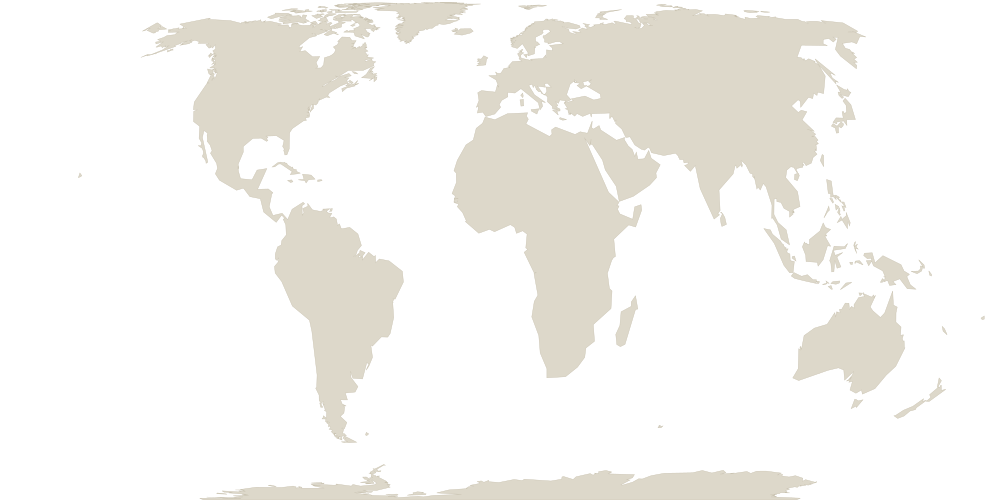
Native range 24 botanical countries
| Region | TDWG code | Continent |
|---|---|---|
| Albania | ALB | EUROPE |
| Baleares | BAL | |
| Bulgaria | BUL | |
| Greece | GRC | |
| Italy | ITA | |
| Kriti | KRI | |
| Krym | KRY | |
| NW. Balkan Pen. | YUG | |
| Portugal | POR | |
| Sicilia | SIC | |
| Spain | SPA | |
| Türkiye-in-Europe | TUE | |
| Cyprus | CYP | ASIA-TEMPERATE |
| East Aegean Is. | EAI | |
| Lebanon-Syria | LBS | |
| North Caucasus | NCS | |
| Palestine | PAL | |
| Transcaucasus | TCS | |
| Türkiye | TUR | |
| Turkmenistan | TKM | |
| Algeria | ALG | AFRICA |
| Libya | LBY | |
| Morocco | MOR | |
| Tunisia | TUN |
Region boundaries approximated from Natural Earth (public domain) and mapped to TDWG World Geographical Scheme for Recording Plant Distributions (WGSRPD) level-3 botanical countries (Brummitt 2001). Indicative, not the official WGSRPD geometry.
Also published as 22 synonyms
A synonym is not an error. It is a record of botanists disagreeing, in print, about where this plant belongs. Each of these was somebody’s considered answer.
- Flipanta ovata Raf.
- Horminum coloratum Moench
- Horminum sativum Mill.
- Horminum viride (L.) Moench
- Ormilis horminum (L.) Raf.
- Ormilis viridis (L.) Raf.
- Salvia colorata Thore
- Salvia comosa Salisb.
- Salvia dolichorrhiza Caball.
- Salvia horminum L.
- Salvia horminum var. angustifolia Boiss.
- Salvia horminum var. hypoleuca Briq.
- Salvia horminum var. intermedia Briq.
- Salvia horminum var. viridis (L.) Caruel
- Salvia intercedens Pobed.
- Salvia rosani Ten.
- Salvia spielmannii Scop.
- Salvia truncata Willd.
- Salvia viridis var. comata Heldr.
- Salvia viridis var. horminum (L.) Batt.
- Salvia viridis var. violacea Benth.
- Sclarea viridis (L.) Soják
Sourcesevery claim on this page
- World Flora Online Plant List. accepted name, authority, classification. CC0. Retrieved 2026-07-12.
- iNaturalist. photographs and flowering annotations, CC0 / CC BY / CC BY-SA only. per photograph. Retrieved 2026-06-27.
- Wikidata. common name (P1843), joined on the World Flora Online identifier (P7715). CC0. Retrieved 2026-07-13.
- Kew, World Checklist of Vascular Plants (WCVP v16). native distribution by TDWG level-3 botanical country, and life form. CC BY 3.0. Retrieved 2026-06-04.
We publish what we can source and we say so when we cannot. This page has no care advice and no toxicity claim, because we do not yet have those from a source we can cite.