Plate 1 figs. a–c · 1 observation
This species has been photographed under an open licence only 1 time, so some figures below are different views of the same plant, taken on the same day, rather than different individuals. They are usually different parts of it: the leaf, the flower, the bark.


Every figure is a research-grade observation under CC0, CC BY or CC BY-SA, rehosted with the photographer’s name, the licence and the observation it came from. Photographs under a NonCommercial licence are excluded from this site and are never stored, which costs us a great many pictures and is not negotiable.
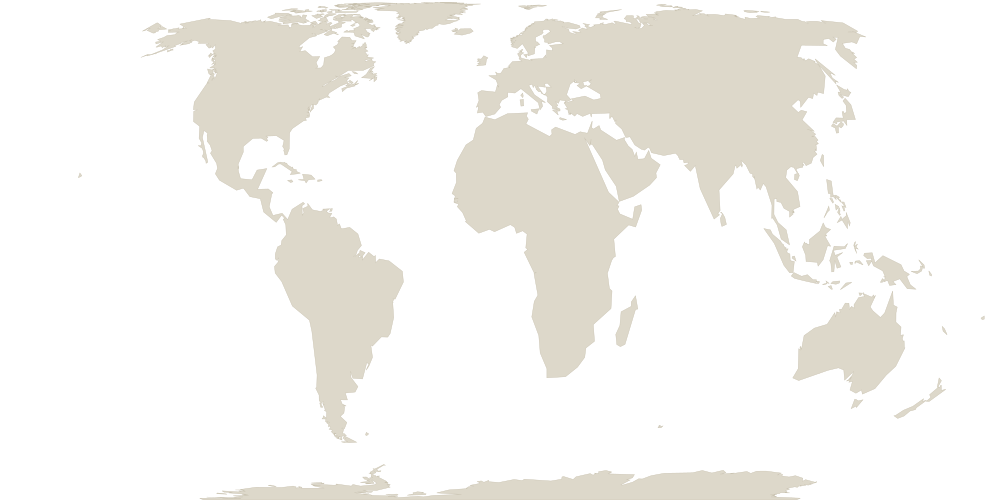
Native range 16 botanical countries
| Region | TDWG code | Continent |
|---|---|---|
| Assam | ASS | ASIA-TROPICAL |
| Bangladesh | BAN | |
| Borneo | BOR | |
| Cambodia | CBD | |
| East Himalaya | EHM | |
| Jawa | JAW | |
| Laos | LAO | |
| Malaya | MLY | |
| Maluku | MOL | |
| Myanmar | MYA | |
| Philippines | PHI | |
| Sulawesi | SUL | |
| Sumatera | SUM | |
| Thailand | THA | |
| Vietnam | VIE | |
| Hainan | CHH | ASIA-TEMPERATE |
Region boundaries approximated from Natural Earth (public domain) and mapped to TDWG World Geographical Scheme for Recording Plant Distributions (WGSRPD) level-3 botanical countries (Brummitt 2001). Indicative, not the official WGSRPD geometry.
Also published as 12 synonyms
A synonym is not an error. It is a record of botanists disagreeing, in print, about where this plant belongs. Each of these was somebody’s considered answer.
- Aerides densiflora (Lindl.) Wall. ex Hook.f.
- Cleisostoma robustum Guillaumin
- Cleisostoma spathulatum Blume
- Cleisostoma spicatum Lindl.
- Gastrochilus densiflorus (Lindl.) Kuntze
- Pomatocalpa densiflorum (Lindl.) Tang & F.T.Wang
- Rhynchostylis densiflora (Lindl.) L.O.Williams
- Saccolabium acutilabrum Gagnep.
- Saccolabium borneense Rchb.f.
- Saccolabium densiflorum Lindl.
- Sarcanthus castaneus Ridl.
- Sarcanthus densiflorus (Lindl.) C.S.P.Parish & Rchb.f.
Sourcesevery claim on this page
- World Flora Online Plant List. accepted name, authority, classification. CC0. Retrieved 2026-07-12.
- iNaturalist. photographs and flowering annotations, CC0 / CC BY / CC BY-SA only. per photograph. Retrieved 2026-06-27.
- Kew, World Checklist of Vascular Plants (WCVP v16). native distribution by TDWG level-3 botanical country, and life form. CC BY 3.0. Retrieved 2026-06-04.
We publish what we can source and we say so when we cannot. This page has no care advice and no toxicity claim, because we do not yet have those from a source we can cite.