Plate 1 figs. a–c · 3 separate observations


Every figure is a research-grade observation under CC0, CC BY or CC BY-SA, rehosted with the photographer’s name, the licence and the observation it came from. Photographs under a NonCommercial licence are excluded from this site and are never stored, which costs us a great many pictures and is not negotiable.
The specimen a real sheet, in a real collection
- Herbarium
- The New York Botanical Garden
- Accession
- 02650917
- Filed as
- Pinalia bractescens (Lindl.) Kuntze
- Det. by
- H. Kurzweil 2018-07-27
- Collected
- J. E. McMillen 1945-04-27
- Origin
- MM
- The sheet
- View the digitised specimen (CC BY 4.0)
A real pressed plant, in a real collection, under the accession number above. Not an illustration of one. The holding institution does not serve this sheet’s image to third parties, so there is no photograph here. The record is real and the link goes to it. Where we hold no openly licensed sheet for a species this section is simply absent, and where a sheet never recorded who determined it, that field stays empty rather than being filled in. Roughly half of all herbarium sheets never recorded a determiner, which is ordinary.
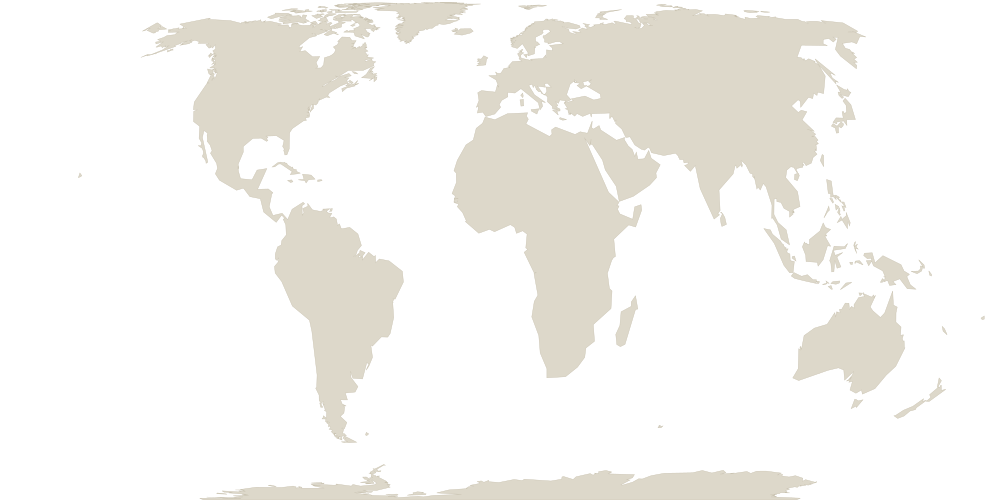
Native range 18 botanical countries
| Region | TDWG code | Continent |
|---|---|---|
| Andaman Is. | AND | ASIA-TROPICAL |
| Assam | ASS | |
| Bangladesh | BAN | |
| Borneo | BOR | |
| Cambodia | CBD | |
| East Himalaya | EHM | |
| Laos | LAO | |
| Malaya | MLY | |
| Maluku | MOL | |
| Myanmar | MYA | |
| Nepal | NEP | |
| New Guinea | NWG | |
| Nicobar Is. | NCB | |
| Philippines | PHI | |
| Sulawesi | SUL | |
| Sumatera | SUM | |
| Thailand | THA | |
| Vietnam | VIE |
Region boundaries approximated from Natural Earth (public domain) and mapped to TDWG World Geographical Scheme for Recording Plant Distributions (WGSRPD) level-3 botanical countries (Brummitt 2001). Indicative, not the official WGSRPD geometry.
Also published as 13 synonyms
A synonym is not an error. It is a record of botanists disagreeing, in print, about where this plant belongs. Each of these was somebody’s considered answer.
- Dendrobium subterrestre Gagnep.
- Eria bractescens Lindl.
- Eria bractescens var. kurzii Hook.f.
- Eria bractescens var. latipetala Leav.
- Eria griffithii Rchb.f.
- Eria kurzii Anderson ex Hook.f.
- Eria lactea Kraenzl.
- Eria littoralis Teijsm. & Binn.
- Eria pulchella Griff.
- Pinalia pulchella Kuntze
- Trias bractescens (Lindl.) Mason
- Trias pulchella Mason
- Tropilis subterrestris (Gagnep.) Rauschert
Sourcesevery claim on this page
- World Flora Online Plant List. accepted name, authority, classification. CC0. Retrieved 2026-07-12.
- iNaturalist. photographs and flowering annotations, CC0 / CC BY / CC BY-SA only. per photograph. Retrieved 2026-06-27.
- Kew, World Checklist of Vascular Plants (WCVP v16). native distribution by TDWG level-3 botanical country, and life form. CC BY 3.0. Retrieved 2026-06-04.
We publish what we can source and we say so when we cannot. This page has no care advice and no toxicity claim, because we do not yet have those from a source we can cite.