Plate 1 figs. a–h · 8 separate observations


Every figure is a research-grade observation under CC0, CC BY or CC BY-SA, rehosted with the photographer’s name, the licence and the observation it came from. Photographs under a NonCommercial licence are excluded from this site and are never stored, which costs us a great many pictures and is not negotiable.
Native range 25 botanical countries
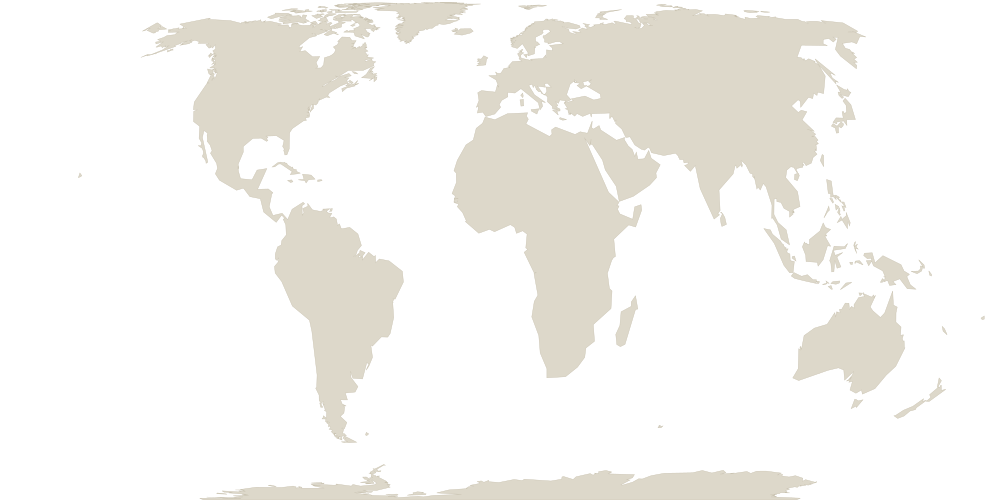
| Region | TDWG code | Continent |
|---|---|---|
| Argentina Northeast | AGE | SOUTHERN AMERICA |
| Bahamas | BAH | |
| Brazil North | BZN | |
| Brazil Northeast | BZE | |
| Brazil South | BZS | |
| Brazil Southeast | BZL | |
| Brazil West-Central | BZC | |
| Central American Pacific Is. | CPI | |
| Colombia | CLM | |
| Cuba | CUB | |
| Dominican Republic | DOM | |
| French Guiana | FRG | |
| Guyana | GUY | |
| Haiti | HAI | |
| Jamaica | JAM | |
| Leeward Is. | LEE | |
| Netherlands Antilles | NLA | |
| Puerto Rico | PUE | |
| Suriname | SUR | |
| Trinidad-Tobago | TRT | |
| Venezuela | VEN | |
| Windward Is. | WIN | |
| Alabama | ALA | NORTHERN AMERICA |
| Florida | FLA | |
| Georgia | GEO |
Region boundaries approximated from Natural Earth (public domain) and mapped to TDWG World Geographical Scheme for Recording Plant Distributions (WGSRPD) level-3 botanical countries (Brummitt 2001). Indicative, not the official WGSRPD geometry.
Also published as 17 synonyms
A synonym is not an error. It is a record of botanists disagreeing, in print, about where this plant belongs. Each of these was somebody’s considered answer.
- Chrysopteris aurea (L.) Link
- Chrysopteris grandis Fée
- Chrysopteris martinicensis Fée
- Chrysopteris microdictya Fée
- Chrysopteris pulvinata Link
- Phlebodium aureum var. pulvinatum Farw.
- Phlebodium grande T.Moore
- Phlebodium microdictyum T.Moore
- Phlebodium pulvinatum J.Sm.
- Pleopeltis aurea (L.) C.Presl
- Polypodium attenuatum Kuntze ex Ettingsh.
- Polypodium auratum Vell.
- Polypodium aureum L.
- Polypodium aureum var. leucatomos Krug
- Polypodium aureum var. pulvinatum (Link) Baker
- Polypodium leucatomos Poir.
- Polypodium pulvinatum Link
Sourcesevery claim on this page
- World Flora Online Plant List. accepted name, authority, classification. CC0. Retrieved 2026-07-12.
- iNaturalist. photographs and flowering annotations, CC0 / CC BY / CC BY-SA only. per photograph. Retrieved 2026-06-27.
- Wikidata. common name (P1843), joined on the World Flora Online identifier (P7715). CC0. Retrieved 2026-07-13.
- Kew, World Checklist of Vascular Plants (WCVP v16). native distribution by TDWG level-3 botanical country, and life form. CC BY 3.0. Retrieved 2026-06-04.
We publish what we can source and we say so when we cannot. This page has no care advice and no toxicity claim, because we do not yet have those from a source we can cite.