Plate 1 figs. a–h · 6 observations
This species has been photographed under an open licence only 6 times, so some figures below are different views of the same plant, taken on the same day, rather than different individuals. They are usually different parts of it: the leaf, the flower, the bark.


Every figure is a research-grade observation under CC0, CC BY or CC BY-SA, rehosted with the photographer’s name, the licence and the observation it came from. Photographs under a NonCommercial licence are excluded from this site and are never stored, which costs us a great many pictures and is not negotiable.
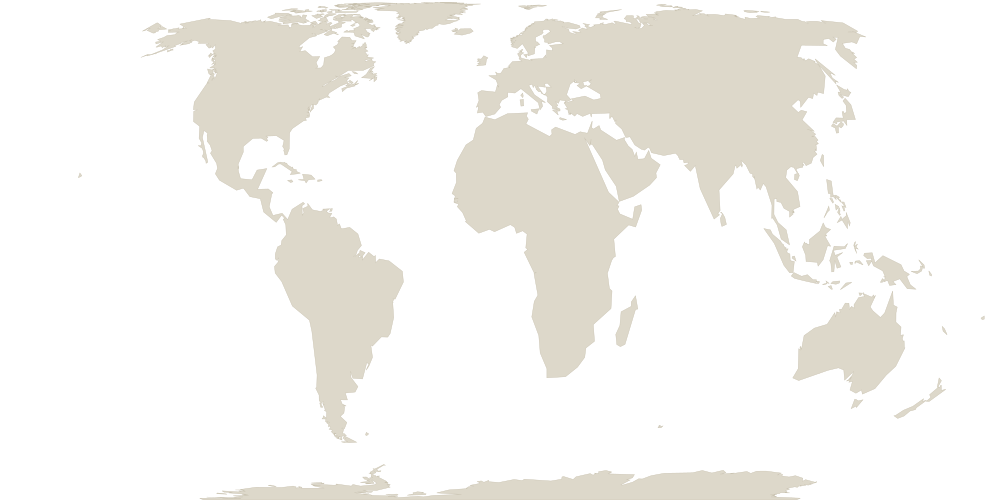
Native range 42 botanical countries
| Region | TDWG code | Continent |
|---|---|---|
| Austria | AUT | EUROPE |
| Belarus | BLR | |
| Belgium | BGM | |
| Bulgaria | BUL | |
| Central European Russia | RUC | |
| Czechia-Slovakia | CZE | |
| East European Russia | RUE | |
| France | FRA | |
| Greece | GRC | |
| Italy | ITA | |
| Kriti | KRI | |
| Krym | KRY | |
| Netherlands | NET | |
| Northwest European Russia | RUW | |
| NW. Balkan Pen. | YUG | |
| Portugal | POR | |
| Romania | ROM | |
| Sardegna | SAR | |
| Sicilia | SIC | |
| South European Russia | RUS | |
| Spain | SPA | |
| Switzerland | SWI | |
| Türkiye-in-Europe | TUE | |
| Ukraine | UKR | |
| Afghanistan | AFG | ASIA-TEMPERATE |
| Gulf States | GST | |
| Iran | IRN | |
| Iraq | IRQ | |
| Kuwait | KUW | |
| Lebanon-Syria | LBS | |
| Oman | OMA | |
| Palestine | PAL | |
| Saudi Arabia | SAU | |
| Sinai | SIN | |
| Tadzhikistan | TZK | |
| Türkiye | TUR | |
| Turkmenistan | TKM | |
| Yemen | YEM | |
| Lesser Sunda Is. | LSI | ASIA-TROPICAL |
| Pakistan | PAK | |
| West Himalaya | WHM | |
| Egypt | EGY | AFRICA |
Region boundaries approximated from Natural Earth (public domain) and mapped to TDWG World Geographical Scheme for Recording Plant Distributions (WGSRPD) level-3 botanical countries (Brummitt 2001). Indicative, not the official WGSRPD geometry.
Also published as 15 synonyms
A synonym is not an error. It is a record of botanists disagreeing, in print, about where this plant belongs. Each of these was somebody’s considered answer.
- Arabis chinensis Rottler ex Wight
- Cardamon sativum (L.) Fourr.
- Crucifera nasturtium E.H.L.Krause
- Lepia sativa (L.) Desv.
- Lepidium hortense Forssk.
- Lepidium sativum subsp. sativum L.
- Lepidium sativum var. crispum DC.
- Lepidium sativum var. schimperi Thell.
- Lepidium sativum var. silvestre Thell.
- Lepidium sativum var. typicum Thell.
- Nasturtium crispum Medik.
- Nasturtium hortense Garsault
- Nasturtium sativum (L.) Moench
- Thlaspi sativum (L.) Crantz
- Thlaspidium sativum (L.) Spach
Sourcesevery claim on this page
- World Flora Online Plant List. accepted name, authority, classification. CC0. Retrieved 2026-07-12.
- iNaturalist. photographs and flowering annotations, CC0 / CC BY / CC BY-SA only. per photograph. Retrieved 2026-06-27.
- Wikidata. common name (P1843), joined on the World Flora Online identifier (P7715). CC0. Retrieved 2026-07-13.
- Kew, World Checklist of Vascular Plants (WCVP v16). native distribution by TDWG level-3 botanical country, and life form. CC BY 3.0. Retrieved 2026-06-04.
We publish what we can source and we say so when we cannot. This page has no care advice and no toxicity claim, because we do not yet have those from a source we can cite.