Plate 1 figs. a–h · 8 separate observations


Every figure is a research-grade observation under CC0, CC BY or CC BY-SA, rehosted with the photographer’s name, the licence and the observation it came from. Photographs under a NonCommercial licence are excluded from this site and are never stored, which costs us a great many pictures and is not negotiable.
The specimen a real sheet, in a real collection
- Herbarium
- The New York Botanical Garden
- Accession
- 01527811
- Filed as
- Geranium sibiricum L.
- Det. by
- D. E. Atha 2012-01-01
- Collected
- D. E. Atha 2011-07-09
- Origin
- US
- The sheet
- View the digitised specimen (CC BY 4.0)
A real pressed plant, in a real collection, under the accession number above. Not an illustration of one. The holding institution does not serve this sheet’s image to third parties, so there is no photograph here. The record is real and the link goes to it. Where we hold no openly licensed sheet for a species this section is simply absent, and where a sheet never recorded who determined it, that field stays empty rather than being filled in. Roughly half of all herbarium sheets never recorded a determiner, which is ordinary.
Native range 40 botanical countries
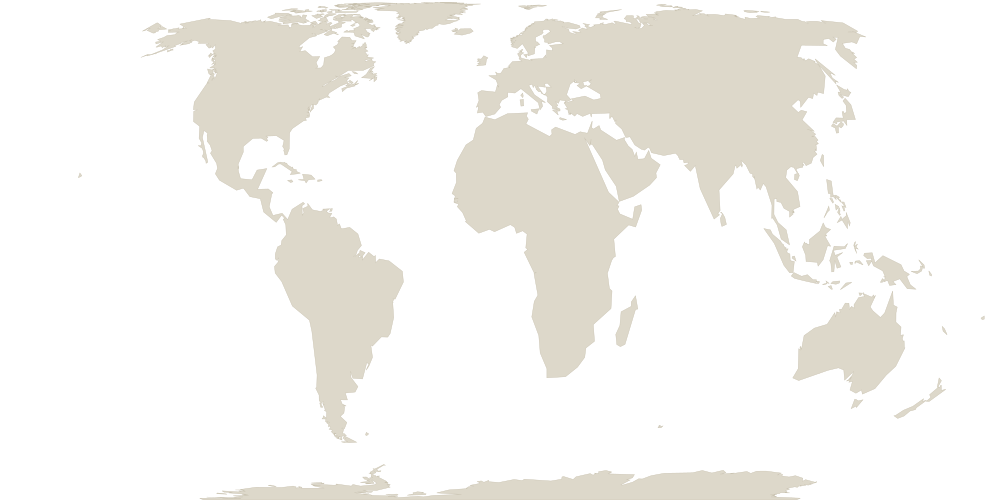
| Region | TDWG code | Continent |
|---|---|---|
| Afghanistan | AFG | ASIA-TEMPERATE |
| Altay | ALT | |
| Amur | AMU | |
| Buryatiya | BRY | |
| China North-Central | CHN | |
| China South-Central | CHC | |
| China Southeast | CHS | |
| Inner Mongolia | CHI | |
| Irkutsk | IRK | |
| Japan | JAP | |
| Kamchatka | KAM | |
| Kazakhstan | KAZ | |
| Khabarovsk | KHA | |
| Kirgizstan | KGZ | |
| Korea | KOR | |
| Krasnoyarsk | KRA | |
| Magadan | MAG | |
| Manchuria | CHM | |
| Mongolia | MON | |
| North Caucasus | NCS | |
| Primorye | PRM | |
| Qinghai | CHQ | |
| Tadzhikistan | TZK | |
| Tibet | CHT | |
| Transcaucasus | TCS | |
| Türkiye | TUR | |
| Tuva | TVA | |
| Uzbekistan | UZB | |
| West Siberia | WSB | |
| Xinjiang | CHX | |
| Yakutiya | YAK | |
| Baltic States | BLT | EUROPE |
| Bulgaria | BUL | |
| Central European Russia | RUC | |
| East European Russia | RUE | |
| Northwest European Russia | RUW | |
| Romania | ROM | |
| South European Russia | RUS | |
| Ukraine | UKR | |
| West Himalaya | WHM | ASIA-TROPICAL |
Region boundaries approximated from Natural Earth (public domain) and mapped to TDWG World Geographical Scheme for Recording Plant Distributions (WGSRPD) level-3 botanical countries (Brummitt 2001). Indicative, not the official WGSRPD geometry.
Flowering 527 in flower of 671 examined
Peak flowering in Aug. Each bar is the share of Geranium sibiricum observations in which someone actually recorded the reproductive state and found the plant in flower, not the raw number of flowering records. That distinction matters: people observe plants far more in spring than in winter, so a bare count of flowering records partly measures when people go outside. Dividing by the number examined removes that. 527 of 671 examined observations were in flower, every one of them research grade. The whisker on each bar is a 95% Wilson interval. 5 months have fewer than 5 examined observations, so no proportion is drawn for them. This is still a global aggregate and not a forecast for your garden: the same species flowers on different dates in different hemispheres. Where a species has fewer than 30 flowering records we do not draw this chart at all. Computed from 10.15468/dl.cgje2x.
Where it actually grows measured, from 2,002 observations
| Condition | 5th percentile | Median | 95th percentile |
|---|---|---|---|
| Coldest month, mean daily low | -24.7 °C | -12.1 °C | -5.8 °C |
| Warmest month, mean daily high | 21.9 °C | 23.2 °C | 25.9 °C |
| Annual rainfall | 401 mm | 616 mm | 910 mm |
| Rainfall in the driest quarter | 32 mm | 97 mm | 126 mm |
It is found where winters are severely cold. This is not care advice and it is not a forecast. It is a measurement: we sampled the climate at every one of the 2,002 research-grade observations of Geranium sibiricum that carry a coordinate, and this is the range those places actually span. The 5th and 95th percentiles are used rather than the minimum and maximum, because a single cultivated specimen in a heated conservatory should not widen a tropical plant's range to the Arctic.
This is not a hardiness zone. A USDA zone is the average annual extreme minimum temperature. The figure above is the mean daily minimum of the coldest month, which is a different quantity and is typically far warmer. Reading one as the other would place a plant several zones too warm, so we do not publish a hardiness zone, because we do not have one. Climate from CHELSA V2.1 (Karger et al. 2017); occurrences from 10.15468/dl.cgje2x.
Also published as 15 synonyms
A synonym is not an error. It is a record of botanists disagreeing, in print, about where this plant belongs. Each of these was somebody’s considered answer.
- Geranium acrocarphum Ledeb.
- Geranium amurense Tsyren.
- Geranium europaeum Popov ex Bobrov
- Geranium europaeum Popov
- Geranium popovii (Tzvelev) Tzvelev
- Geranium rotundifolium Ledeb. ex B.D.Jacks.
- Geranium ruthenicum R.Uechtr.
- Geranium sibiricum f. glabrius H.Hara
- Geranium sibiricum subsp. eusibiricum Gams
- Geranium sibiricum subsp. popovii Tzvelev
- Geranium sibiricum subsp. ruthenicum (R.Uechtr.) Nyman
- Geranium sibiricum subsp. ruthenicum (R.Uechtr.) Gams
- Geranium sibiricum var. glabrius (H.Hara) Ohwi
- Geranium sibiricum var. multiflorum Z.H.Lu
- Geranium variabile Moench
Sourcesevery claim on this page
- World Flora Online Plant List. accepted name, authority, classification. CC0. Retrieved 2026-07-12.
- iNaturalist. photographs and flowering annotations, CC0 / CC BY / CC BY-SA only. per photograph. Retrieved 2026-06-27.
- Wikidata. common name (P1843), joined on the World Flora Online identifier (P7715). CC0. Retrieved 2026-07-13.
- Kew, World Checklist of Vascular Plants (WCVP v16). native distribution by TDWG level-3 botanical country, and life form. CC BY 3.0. Retrieved 2026-06-04.
We publish what we can source and we say so when we cannot. This page has no care advice and no toxicity claim, because we do not yet have those from a source we can cite.